Best vegan scanner apps compared: 7 options, prices and one drawback each
The short answer
There is no single best vegan scanner app. Pick by how you shop. For big-brand groceries in one country, a barcode app such as Yuka or the free Open Food Facts is enough. For imports, bakery items or labels in other languages, use an app that reads the printed ingredient list, such as Is It Vegan?, Soosee or WhatsVegan. Whatever you choose, check how it handles ingredients that can be plant or animal, because that is where most uncertainty sits.
This comparison covers seven apps that answer the question "is this vegan?" at the shelf. We make one of them, WhatsVegan, so we have not ranked them. Each app gets what it does, what it costs and one real drawback, ours included. Prices and features come from each vendor's own App Store listing or help pages, checked on November 24, 2026. We did not test the other apps hands-on.
The part most comparisons skip
Spotting milk or egg is easy for any scanner. The hard part is ingredients whose source the label doesn't give. In 14,411 food labels scanned in the WhatsVegan app, 2,596 (18.0%) contained a clearly animal ingredient. Another 5,931 (41.2%) had no animal ingredient but did have at least one that can come from either plants or animals, such as natural flavourings or E471. On 3,148 labels, natural flavourings alone were the open question.
More labels in our data were uncertain than were clearly not vegan. An app that calls all of those "vegan" looks confident and is sometimes wrong. An app that calls them "not vegan" makes you put back food you could eat. The column "How it handles 'depends'" in the table below is the one we would read first.
Seven apps side by side
Prices are US App Store prices on November 24, 2026 and vary by country.
| App | What it reads | How it handles "depends" | Price | Platforms |
|---|---|---|---|---|
| Yuka | Barcode | Premium alert: suitable or not for your diet | Free; Premium $10, $15 or $20 a year (same features) | iPhone, iPad, Android |
| Open Food Facts | Barcode (community database) | Vegan, non-vegan, maybe vegan or unknown | Free, non-profit | iPhone, iPad, Android |
| Fig | Barcode | Match or no match for your profile, per ingredient | Free with 5 scans a month; Fig+ from $5.99 a month | iPhone, Android (US only) |
| Soosee | Live camera on the ingredient list | Highlights words from lists you switch on; no verdict | Free; optional Supporter from $1.99, or $13.99 lifetime | iPhone, Apple Watch |
| Is It Vegan? | Photo of the ingredient list, product search | Vegan verdict with the ingredients that fail | Free; subscriptions from $1.99 a month, $9.99 a year, $19.99 lifetime | iPhone, iPad |
| VeganCheckr | Barcode (Open Food Facts data), ingredient photo or text | Vegan, non-vegan, potentially animal-derived or not enough information | Free; Premium weekly, yearly or lifetime ($0.99 to $29.99) | iPhone, Android |
| WhatsVegan | Photo of the ingredient list | Each ingredient green, red or orange ("depends") | $3.99 a month or $29.99 a year (7-day trial on yearly) | iPhone, iPad, Android |
Barcode apps
Barcode apps look the product up in a database. They are fast and show more than the vegan answer, but they can only answer for products someone has already added, and the record can be older than the recipe on the pack.
Yuka
Yuka scores food and cosmetics on health, and its listing says it has about 4 million food products. Vegan and vegetarian are Premium alerts: once switched on, Yuka tells you when a scanned product doesn't suit your diet. Premium is a yearly membership where you choose to pay $10, $15 or $20, and Yuka's help centre says the features are the same at every price. Premium also adds an offline mode.
Drawback: vegan alerts need Premium; the free version only shows the ingredient list. Yuka's help centre also says it ignores "may contain" traces and can't guarantee the accuracy of its data. The main score is about health, not about whether a product is vegan.
Open Food Facts
Open Food Facts is a non-profit, volunteer-built food database that more than 150 other apps, Yuka among them, have been built on, according to its listing. It is free and has no ads. It analyses each product's ingredient list and labels it vegan, non-vegan, maybe vegan or unknown. If a product is missing, you can add photos and the community fills in the record.
Drawback: its own documentation says ingredient parsing "might not be perfect" and can have issues in some languages. Records are entered by volunteers, so regional products are often missing or incomplete.
Fig
Fig is built for people with several dietary rules at once. It supports more than 2,800 diets and allergies, lets you make a profile for each family member, and shows why a given ingredient doesn't match. Its ingredient notes come from a team of dietitians, and it lists suitable products at US grocery stores.
Drawback: Fig says it is only available in the US, and the free version gives 5 scans a month. Unlimited scans need Fig+, whose listed prices run from $5.99 a month to $69.99, depending on the plan and offer.
Apps that read the label
These apps work from the ingredient list printed on the pack, so they work on products no database has. The trade-off is that the photo has to be readable, and they show no nutrition or health score.
Soosee
Soosee highlights words in the live camera view. You switch on lists such as "General Non-Vegan", "Animal Derived E-Numbers", dairy or egg, and it marks every match on the label. It works offline, reads 17 languages and is free. A Supporter subscription adds unlimited custom lists and other extras.
Drawback: it highlights words but doesn't give a verdict, so ingredients like natural flavourings or E471 are left to you. That suits people who already know the ingredients and want a faster read.
Is It Vegan?
One of the oldest vegan apps, around since 2012. The current iPhone version reads a photo of any ingredient list in over 100 languages, according to its listing, and has a searchable product database with over 20,000 categorised ingredients. Its annual subscription is listed at $9.99.
Drawback: the current version is listed for iPhone and iPad only, and with 16 ratings on the US App Store there is little user feedback on how well the new photo reading works.
VeganCheckr
VeganCheckr combines both approaches: barcode lookups, plus a photo or typed ingredient list when the barcode isn't found. Its Android listing says results can be vegan, non-vegan, potentially animal-derived or insufficient information, and that it separates "may contain" statements from ingredients.
Drawback: barcode results come from Open Food Facts, so they are not an independent second opinion on that database. Its Google Play listing says full ingredient details need Premium.
WhatsVegan
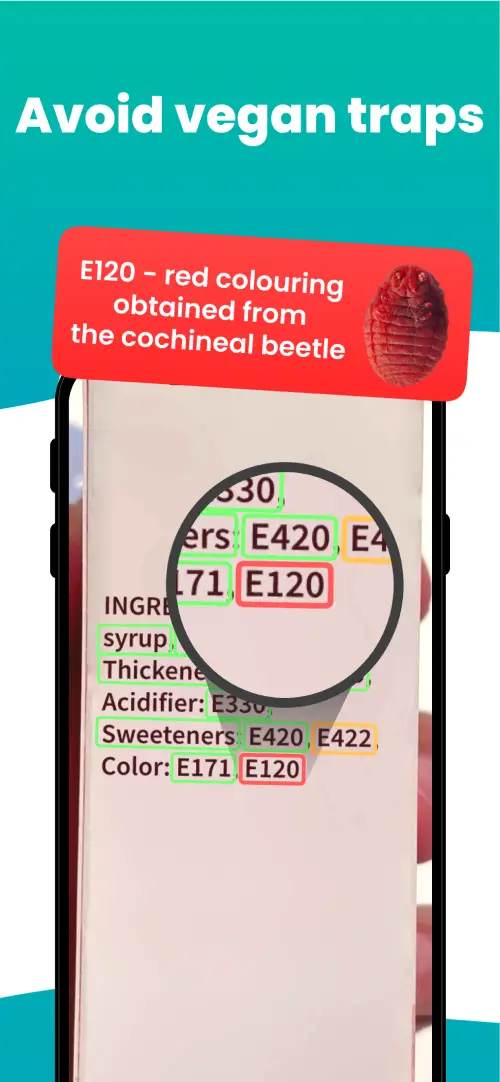
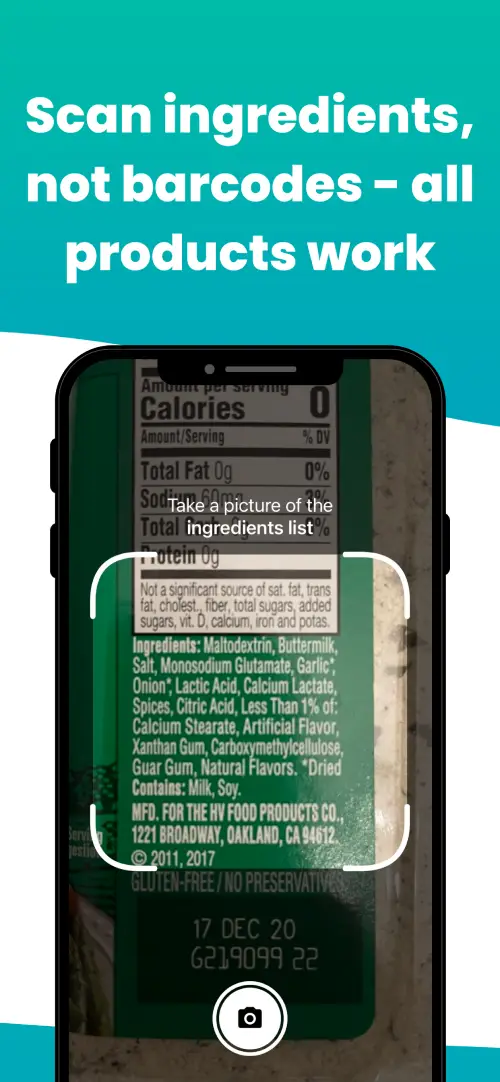
This is our app. You photograph the ingredient list and every ingredient is marked green (vegan), red (not vegan) or orange (depends on the source), with a short description of each one. It doesn't use barcodes, so a product doesn't need to be in any database. One subscription covers the family through Family Sharing.
Drawback: the scanner is a paid feature, at $3.99 a month or $29.99 a year, and the only free period is the 7-day trial on the yearly plan. It needs a sharp photo of the whole list, and it shows nothing about nutrition. If you only want to check a few products, the free vegan ingredient checker on this site does the same classification on pasted or typed text.
Which one to pick
- You shop at big supermarkets in one country: a barcode app. Open Food Facts if you want free, Yuka Premium if you also care about health scores.
- You follow several diets or allergies in the US: Fig.
- You travel or buy imported food: an app that reads the label. Is It Vegan? and WhatsVegan give a verdict; Soosee highlights words and works offline.
- You already know your ingredients: Soosee, which is free and doesn't need a connection.
- You want to see what is uncertain and why: pick an app with a separate "depends" result (Open Food Facts, VeganCheckr, WhatsVegan) rather than a plain yes or no.
What no scanner can tell you
Every app here reads the ingredient list or a copy of it. None can see how an ingredient was processed. Cane sugar filtered through bone char, wine fined with gelatine and flavourings made from meat look the same on the label as their vegan versions. For those, a vegan certification mark or an answer from the manufacturer is the only full answer. Scanners also don't judge "may contain" warnings, which are about cross contact in the factory, not ingredients. Our list of non-vegan E-numbers and label analysis cover the ingredients worth learning by heart.
How we compared
We chose apps that appear in the App Store or Google Play for vegan scanner searches, are still updated, and give an answer about vegan ingredients. We read each app's own store listing and, where available, its help pages on November 24, 2026, and quote prices from the US App Store. We did not install and test the other apps, so nothing here describes their accuracy. Features and prices change, so check the listing before you pay.
The scan figures come from 14,411 unique food and supplement ingredient lists scanned in the WhatsVegan app between June 2025 and October 2026, after removing duplicates and cosmetics, and use the same counting as our label analysis. These are products people chose to scan, so they are not a random sample of what is in shops.
Sources
- Yuka, App Store listing and help centre (food preferences, paid features, membership cost): apps.apple.com, help.yuka.io, help.yuka.io
- Open Food Facts, App Store listing and ingredient analysis documentation: apps.apple.com, openfoodfacts.github.io
- Fig, App Store listing and vegan page: apps.apple.com, foodisgood.com
- Soosee, App Store listing: apps.apple.com
- Is It Vegan?, App Store listing: apps.apple.com
- VeganCheckr, App Store and Google Play listings: apps.apple.com, play.google.com
- WhatsVegan, App Store listing: apps.apple.com