
Are chromium oxide greens vegan?
Chromium oxide greens is a vegan food ingredient.
Checking out an ingredients list? 👇
"You are amazing, this has saved me so much time when grocery shopping!"
— Austin, a user who reached out with feedback
"It's been a great tool since starting my journey! You take a pic of the nutrition/ingredients, and it'll warn you of anything questionable or not vegan. 😁"
— Ashe, a Vegan For Beginners Facebook Group member
"Use a vegan app when you go shopping, I use WhatsVegan."
— Dóra, a Vegan For Beginners Facebook Group member
So, what is chromium oxide greens?
Exploring Chromium Oxide Greens: A Cruelty-Free Pigment
For those navigating the landscape of ingredient sourcing with an ethical compass, understanding the origins of every component is paramount. Chromium oxide greens, scientifically known as chromium(III) oxide (Cr₂O₃), stands as a vibrant, stable, and frequently encountered pigment. Its status as a truly vegan ingredient is unequivocally clear, making it a reliable choice for plant-based and cruelty-free product formulations.
Chromium oxide greens is an inorganic compound, meaning its structure is not derived from living organisms. It is synthetically produced through a high-temperature calcination process, typically involving the reduction of sodium dichromate. This industrial synthesis ensures a consistent, high-purity product. The process exclusively utilizes mineral-based precursors and does not, at any stage, involve animal products, byproducts, or animal testing. This inherent lack of animal involvement from raw material to finished pigment firmly establishes its vegan credentials.
From an animal ethics perspective, the synthetic nature of chromium oxide greens is a significant advantage. Unlike some historical or natural green pigments that might raise concerns—such as certain organic dyes or pigments derived from insects or other animal sources—chromium oxide greens offers a clean slate. It stands as a testament to modern chemistry providing solutions that align perfectly with a compassionate lifestyle. Its production avoids animal exploitation entirely, upholding the core principles of the vegan movement regarding non-harm and respect for all sentient beings. This makes it a dependable component for products marketed as cruelty-free.
While not a "plant-based alternative" in the sense of being directly derived from botanicals, it serves a similar function by providing a vibrant green hue without relying on any animal-derived substances. In applications where a stable, intense green is required, and natural plant-based colorants like chlorophyll or spirulina might pose challenges with stability, shade consistency, or regulatory approval for specific uses, chromium oxide greens offers a highly effective and ethically sound alternative. Its robust chemical stability means it resists fading and degradation, making it suitable for a wide array of products where longevity of color is crucial.
Consumers committed to label transparency can be confident when encountering chromium oxide greens (often listed as CI 77288) on ingredient lists for cosmetics, soaps, or other external-use products. It’s important to note, however, that regulatory bodies like the FDA and those in the European Union generally do not approve chromium oxide greens for internal consumption as a food additive. Its primary utility for the vegan consumer will be found in non-food items, such as makeup, soaps, paints, or even in the coloring of packaging materials that house plant-based foods, reinforcing a completely animal-free product journey.
The assurance of its vegan status eliminates the need to investigate complex supply chains for potential animal processing aids or cross-contamination issues that sometimes plague plant-derived ingredients. Its inorganic, synthetic origin sidesteps these "gray area" concerns, presenting a straightforward and ethical choice for those dedicated to a fully vegan lifestyle. In essence, chromium oxide greens offers a powerful, pure green without any ethical compromises.
How to quickly find the source of ingredients like chromium oxide greens?
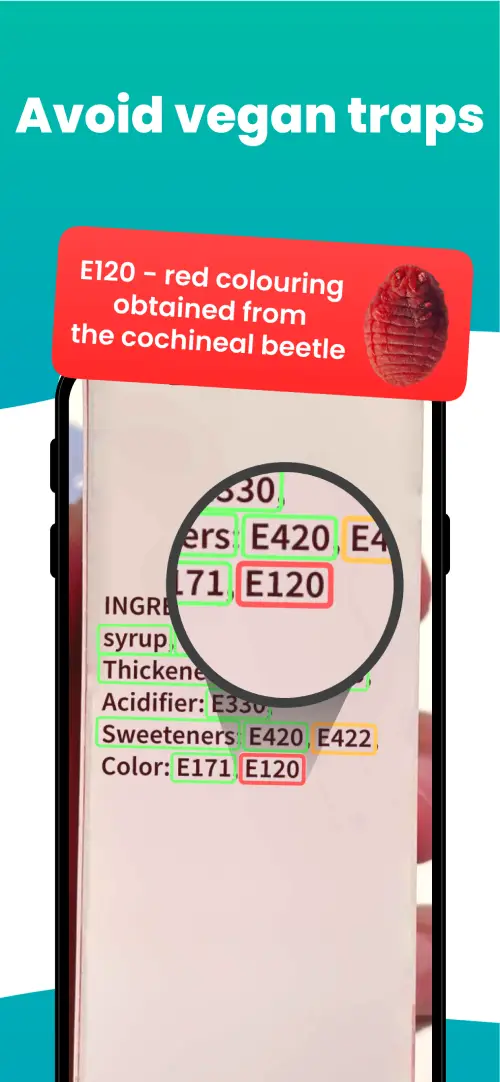
We've built a vegan ingredients scanner that classifies food ingredients as "vegan", "non-vegan", or "potentially vegan".
It allows you to avoid non-vegan ingredients - just take a picture of a product's ingredient list, and the app tells you if the product is vegan or not.




We'll never send you spam.